In Ward 7’s Clay Terrace and Lincoln Heights neighborhoods, families are navigating real struggles, sometimes with limited income, housing instability, food insecurity, and barriers that make stability feel out of reach. But they’re also doing something remarkable: they’re building lives, raising families, and holding onto resilience even when systems aren’t designed to support them.
That’s where the Holmes Richardson Center comes in.
For more than a decade, Sasha Bruce Youthwork (SBY) has been rooted in this community, learning what families actually need and showing up to help. The Holmes Richardson Center is the physical heart of that commitment, a place where neighbors come for food, job training, youth programs, and the kind of support that prevents crisis from becoming homelessness.
What Matters Most
Last year alone, the Center served 325 residents. That’s not just a number, it’s families accessing fresh food when the budget is tight. Young people finding safe spaces after school and learning skills. Parents getting job coaching so they can earn stability. Kids discovering they love art. A community that’s been historically overlooked being told, clearly: we see you, and we’re here.
The Center’s work is deliberately designed by and with the community itself. Years ago, residents formed a Community Advisory Council, not because an organization told them to, but because they wanted a real voice in what support looks like in their neighborhood. That partnership worked. The Center demonstrably reduced the neighborhood’s involvement with the child welfare system, proving that when you trust community members as experts in their own lives, real change happens.
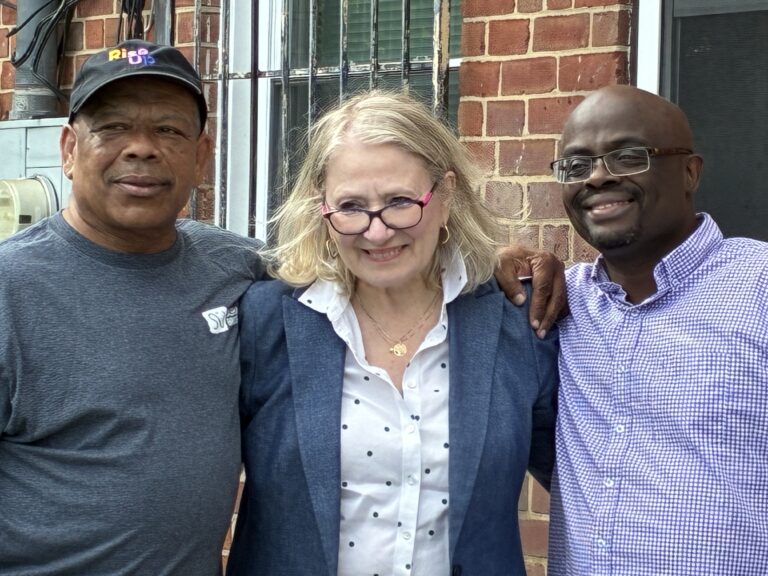
One person who embodies that commitment is Bradley Holmes, a neighborhood resident and now an employee at SBY, who has been a steady, caring presence in Clay Terrace for years. He’s mentored young people, led anti-violence work, and been the kind of neighbor who shows up consistently. So when SBY decided to honor his legacy by naming the Center after him, it felt right, even if Bradley himself had no idea it was coming. (When our team revealed the sign, he was completely surprised.)
The Summer Art Program: One Example of What’s Possible
This summer, the Center is offering something special: a six-week arts program where young people work with local artists, learn techniques rooted in cultural traditions, take field trips to DC-area studios and museums, and get exposed to the legacy and contemporary work of African American artists in this city. It’s hands-on, it’s joyful, and it’s exactly the kind of enrichment that builds confidence and opens possibilities for kids who might not otherwise have access to it.
But this program is just one thread in a much larger tapestry.
The Challenge We’re Facing
Here’s what you should know: a few years ago, the Center lost its city funding, about $350,000 annually. That was the funding that made everything possible at the scale it needed to be. Since then, SBY has made a deliberate choice: we’re keeping the Center open, even though the math is hard. We’re patching together resources and, at this point, we’re using unrestricted internal funds to keep the lights on and the doors open.
It’s important work. The neighborhood needs it. But it’s not sustainable.
That’s the reality. We could have closed. We didn’t, because families in Clay Terrace and Lincoln Heights deserve stability and care, and because the community partnership we’ve built together is too valuable to abandon. But we can’t do this alone, and we can’t keep it going indefinitely without support.
Why This Matters Beyond One Neighborhood
The Holmes Richardson Center represents something bigger than a single community program. It shows what’s possible when organizations listen instead of prescribe, when they partner with residents instead of serving at them, and when they stay committed even when funding disappears.
Every young person who finds safety there. Every parent who gets job training. Every family that stays housed because someone helped them navigate resources. That’s a youth who might not experience homelessness. That’s a family that doesn’t enter crisis. That’s a community that heals instead of fractures.
We know these neighborhoods are strong. We’ve seen it firsthand. But strength alone isn’t enough when the systems around you aren’t designed for your success. That’s where the Center comes in, not to save anyone, but to be a genuine partner in the work families are already doing to take care of themselves.